ERA
GT MK I
AND MK II
Frequently Asked Questions
Also
see our Dedicated Information
Pages at the right for specifications,
parts lists and performance spec's.
Mailing Address 24 Dewey St.New Britain, CT 06051 Tel: 860-224-0253 | Visit Us Here 24 Dewey St.New Britain, CT 06051 |
Why did ERA choose to build the GT?
The GT, even in its original form, was one of the last race car to be adaptable to be a truly streetable car. Later race cars, perhaps because of newer rules, shrank the interior, lowered the ground clearance and generally made the cars more race and less car.
When I receive the standard kit, what will it look like?
It looks like a car without the suspension and interior! The kit is shipped with the body (including the doors, and front and rear body sections) pre-fit and mounted to the chassis. All the lights are installed. The interior is loosely installed and the suspension pieces are packed in boxes.
Can I buy the car in stages, or buy the body or chassis separately?
Sorry. Our standard kit is the least we sell. This is an integrated assembly that doesn't fit "standard" parts. Buying the chassis and body (we fit the body to the chassis to insure quality) without the suspension will make it that much more likely that this will end up an unfinished project..
DESIGN
What's is unique about the E.R.A. GT?
The E.R.A. GT was designed from the beginning to duplicate the original car, in both form and function, while making some subtle but important improvements to make it more "streetable". We have strengthened the chassis, increased the interior space, improved the body finish, and added air-conditioning.Unlike the cheaper kits, our chassis is a close duplicate of the original one: A real monocoque made from 20 gage to 14 gage sheet, but now in stainless steel for corrosion resistance. The only tubes on this chassis are the front frame extensions and the suspension hoops. Safir in England used to make a car with a full monocoque car like ours - for $250,000!
The engine bay has been widened to fit an air conditioning compressor.
The suspension has been somewhat civilized for the street - but remember that only so much can be done with the original suspension design. This car must be thought of as a race car adapted to the street.
The chassis is now stainless steel?
Yes! All the chassis are made from 400 series stainless steel. This alloy is dimensionally more stable when welded than the 300 series while still giving good corrosion protection. With a little care, rust will never be a factor with your car. In addition, the material's strength and ductility makes the chassis even more collision-tough.
What kind of suspension do you use?
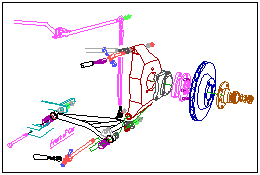
We have tried to duplicate the original GT40's suspension component layout, materials, and geometry as closely as possible, while compensating for wider tires. We make the custom aluminum uprights and tubular control arms . We compromised the components only to fit around some contemporary brakes and bearings.
The front suspension uses unequal and non-parallel control arms that locate the cast aluminum upright with a coil-over damper.
The rear suspension uses long trailing arms locating a reverse "A" arm at the bottom and a single radius arm at the top. Coil-over dampers are used here too. Sliding spline half-shafts transmit the power from the transaxle to the wheels. The end result is barely distinguishable from the original design.
Did you change the body?
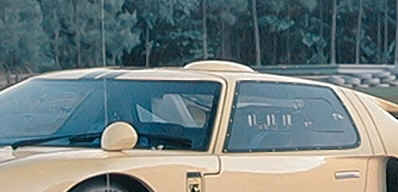
The body is an exact duplicate of the original design on the visible surfaces. We have changed many of the sealing surfaces so that we could use better weather sealing gaskets.Our standard body thickness ranges from 1/8" to 3/16". This is somewhat more than the original GT so that we can make a more stable exterior surface. What this means to you is that you car's finish will be smooth, not wavy, and you won't have the inner panels distorting the outside ones over time. The roof is now laid up in carbon/kevlar for stiffness. The original roof was light gage steel and offered little structurally.
Can I get Right Hand Drive?
Yes, we do a thorough conversion, by shifting the central spine (normally it's offset toward the right in a LHD car). You also get the wiper switched to the right and the shift linkage moved to the right rocker panel, just like the original race cars. Of course the steering gear mount, dashboard and pedals are also modified. All this does cost money, however. See the options.
How much does your car weigh?
About 2300 lbs with an iron 289 engine. This is about 100 lbs more than an original car, the extra weight put into the stronger chassis and thicker body. Air conditioning will add another 120 lbs.
What engine do you recommend?
MK1: We have designed the MK1 around the Ford small block engine, i.e. 260/289/351W. E.R.A. GTs are famous for having the right mechanical parts.MK2: The chassis is designed to accept both the Ford small block and the FE (390/427/428) series with the T44 transaxle. We have also combined a mild FE with the ZF transaxle. We do not support the 385 series Ford engine (429/460).
How about a Cleveland engine?
The 351C will fit, but requires a custom exhaust system. Please inquire for the dimension restrictions that you'll have to meet.
What about the Ford Modular (32V) engine?
We don't have any experience using this engine. Assuming the bell housing will fit, the exhaust looks like it will be very tight against the chassis. Modelling the engine also indicates possible interference at the rear passenger-area bulkhead.
We don't support any Chevrolet engines.
How much room is in the engine compartment?
As you can see from the pictures, the small block Ford engine is fairly tight, and the FE (MK2) is the equivalent to a-quart-in-a-pint-pot. (And don't even think about a 460.)
I've posted a side view of the small-block components (with notes for the MK II) layout here.
That's
a weird exhaust
system! That bundle of snakes is built to collect all 8 pipes into two collectors, where each collector's exhaust pulses are spaced evenly. Because of a V8's 90 degree crank spacing, there's no way to make a single bank of cylinders do that. The net result is a power gain of about 5% over a design that only joins the pipes of a single side. | 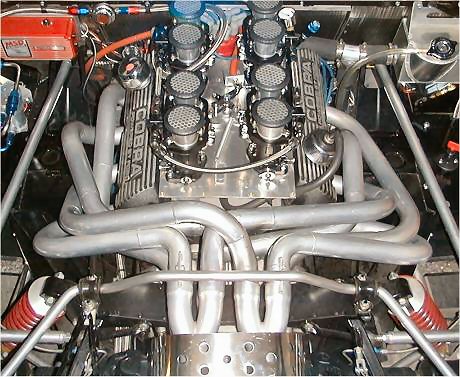 |
Are those Weber carbs?
Yes - both IDA (as original) and IDF (more streetable) are available. But they're not cheap. Figure $3500 to $5000. And we have cold-air boxes and backfire plates for most intake manifolds. Be aware, though, that Webers can be tempermental. For street use, they require certain cams and other equipment to work properly below 3000 rpm.
Can I dry-sump the engine?
The original GT40 used a wet sump system, but a dry sump can be fit - with considerable difficulty. In the sole car that has been converted, the sump was mounted in place of the heater box, on top of the footbox. There was no longer room for air conditioning.
What transaxle?
The car is designed around the ZF transaxle from the Pantera, Mangusta or BMW M1. This is a design continuation of the original transaxle, made a bit stronger with detail improvements. It has a conservative torque rating of about 325 lb.ft. We have looked at many other transaxles. This one - not surprisingly - fits the best. And it looks perfect. It is fairly pricey, though. Prices range from $2000 used to $12,000 brand new. For new and used transaxles and parts, try RBT Transmissions(714-516-1215), Panteras East (727-381-1131) or Pantera Performance (303-360-9848).
Early (4 bolt bellhousing) Pantera transaxles require that the stock bellhousing be modified for upside-down operation. Our car uses the cast aluminum mount/cover (see above) from the Mangusta, available used or from RBT. Later transaxles (Pantera and M!) require the ERA bellhousing. Pantera transaxles require modifications to run in the "upside down" position. M1 transaxles must have the shift mechanism moved to the other side. More information can be had from the Pantera Forum where Lloyd Butfoy (RBT Transmissions) answers questions. Typical gear ratios
(Standard Pantera)1st 2.23 2nd 1.47 3rd 1.04 4th .846 5th .705 Rev. 2.86

Can't I use a different transaxle?
Sorry, but we only support the ZF (MK1) or T44 (MK2). Because of the basic chassis and body design, most other transaxles simply won't fit without major modifications. Qaife promises to have a ZF clone, but we haven't seen one yet.
Many other transaxles don't have the input shaft below the ring gear centerline, and won't work in this application. We cannot do design and development on your own transaxle selection.
What about the shift handle and linkage?
The left-hand-drive model mounts the shift handle on the center console, like the original MK3 street cars. The right-hand-drive model mounts the handle on the right sill, running the shift rod next to the seat. The kit comes with the handle and all the linkage to the transaxle. The handle is spring loaded in the 3-4 gate, and the center shifter has a reverse lockout built in.
What kind of clutch should I use?
Instead of the triple plate clutch of the original, the E.R.A. GT is designed to use a late model Mustang single plate diaphragm clutch. This clutch is rated for 450 lb.ft. Some customers have fit multi-plate clutches too, though.
What
size wheels and tires
will fit? On the front, wheels up to 9" wide will fit with the standard body. You can add 1/2" wheel width with the "1075" body option. The rear will accept wheels up to 12.5" wide with the appropriate offset.
|
 17"
x
9.5" front wheel under 1075
body |
What
are pin-drive
wheels? The very early GTs used narrow wire wheels. These were quickly superseded by cast magnesium wheels secured by a single wing nut. The power was transferred from the hub to the wheel by 6 pins. Widths varied widely according to vintage and the racing team. The competition cars started with 7"F/9R" and worked their way up to 8"F/12R" x 15" diameter made by BRM. Many original designs, widths and diameters are currently available, even 17" pin-drive wheels. |
|

Sources are:
- Trigo, early design pin-drives, 15" x 7.5" and 9.5" wide (818-790-0289)
- PS Engineering, many designs and widths in 15"-17", (310-534-4477)
- Charrington Motorsports
- Mike McClusky - (310-375-1234)
- Jongbloed Modular Wheels (408-776-1380)
- Dralle Engineering (310-530-7931)
- Vintage Wheels (619-952-4717), BRM and Cobra-design

BRM-Design wheel (16" diameter x 12" wide)
All the wheels listed above are available directly from ERA.
If you wish to save some money, you may use bolt-on wheels on our standard hubs.What kind of brakes do you use?
Almost all the brake parts are from late model Corvette. In the front we use 12" diameter x .81" wide vented rotors with floating calipers. These were originally mounted on the front of much heavier cars and are more than adequate for street use. In the rear 12" diameter x .81" thick rotors are mounted. If you use 16" or 17" wheels, you can actually use 13" rotors on the front and rear. Aftermarket conversions that fit Corvette can be installed if you use 17" wheels.The rear calipers have an integral emergency brake mechanism.
The Girling brake and clutch master cylinders are mounted on an adjustable bracket - adjustable fore and aft about 3". Like the original GT, we don't use a booster in the system. The pedal pressure is not light - but very positive.
Is my car going to overheat?
Our standard aluminum cross-flow radiator is oversized for practically any engine. In traffic our standard electric fans will cool everything quite well. If you live in a warm climate, we recommend fitting an oil cooler with engine compartment fan. The original car was not meant to sit still!
PERFORMANCE
How does the car go?
Depending on the engine, 0-60 MPH times will be from 4 to 6 seconds. Top speed is contingent on the final drive ratio. Typical gearing results in about 25 MPH/1000 RPM, or about 150 MPH @ 6000 RPM. The original race cars topped 200 MPH with 400 BHP.How does it stop?
Very well, thanks. Stopping distance from 60 MPH is about 135 ft. The brake balance is adjustable for personal tuning.How does the car ride?
Surprisingly well. Spring rates, while not exactly boulevard settings, are quite reasonable for such a high performance car. If you get the optional Spax or Koni dampers, the damping is externally adjustable, making the transition from street to track a matter of a few minutes with a screwdriver.How does it handle?
Amazing! There is negligible body roll, and response is instant. And yet the car is not at all twitchy. The aerodynamics make the car quite stable at high speed.How about fuel economy and reliability?
You have to ask??? Seriously, the more "stock" the engine is, the better the mpg. You could get 18-24 mpg out of a low horsepower 289 or 302, but with 500 bhp, you'll probably get 12 mpg. If you want the best reliability, stick with a stock engine. Unless you throw a lot of money at an engine, higher horsepower will always result in higher maintenance.
Using a special after-market port injection, Dick Nobile says he's gotten 28 mpg on the highway, with his 450 bhp GT. Of course all this costs money and took a considerable amount of tuning...
How does the GT compare to a modern sports car?
You're more in direct communication with the suspension. Without power steering, you feel much more - and it takes a bit more effort to do things. The GT is noisier than most new cars. It was a race car, with real spherical bearings - not bushings in the rear suspension. It's still reasonable, but this car is not a Lincoln "Bite-wise", the GT will stack up to its equivalent new car, fitted with new rubber. It will easily do over .95G as outfitted for the street. And, with plenty of suspension travel, it doesn't bounce from bump to bump.
Do you have any interior ventilation?
We have foot and face-level vents on both the drivers and passenger's side. The side windows have a small pivoting insert that helps a bit too. Flow through ventilation is also helped by a roof-mounted air exhaust.Air conditioning is also available. Considerable effort has been spent in fitting all the AC components into a box (closely duplicating the original heater container) that sits in the original spare tire well. The spare is moved forward in the front compartment.
Can I get roll-up windows? Sorry, no. The door shape doesn't allow space for a disappearing window, not to meantion the windows are flush with the outside body for better aerodynamics.The large fixed window has a small hinged window within it for a bit of ventilation. I'm LARGE. Will I fit in your car?
Our car will easily accommodate tall people up to 6'5". We have increased the length of the foot-boxes about an inch over the original car and have a vertically adjustable steering column. Our new integral seats put the seatback right against the rear bulkhead panel, and the pedal box (including the steering wheel) is adjustable by about 4.5" fore and aft. Changing the seat padding will allow you to sit practically on the floor too, which has a 1/2" drop already. We also have widened the cockpit about 1.5" on each side over the original car. Our standard driver's seat is also about 1" wider than the original.
If you are really tall, we also offer a "Gurney Bubble" - a door modification that was done originally for Dan (6'5") Gurney. What about interior noise?
The GT is not a Lincoln, but normal conversation is possible even at high speeds (and with a GT, high speeds are really high. If you wish, we can install special acoustic panels to reduce panel drumming. In the end though, you must remember that the ERA GT is derived from a race car, and transmits quite a bit of road "rumble".Surprisingly, the exhaust is not the worst offender. Even with straight pipes, the noise is headed to the rear and is not especially obtrusive (for the driver, at least!) Weber carburetors without air cleaners are quite noisy, being only about one foot from your ears.
You have two different dashboard layouts?
We offer both the original competition layout and the MK3 street layout. They vary mostly in the switch placement. Both have full instrumentation with the speedometer mounted in front of the passenger.I've seen some different fender shapes on some of the cars.
E.R.A. offers two different flare configurations. Our standard flares match the 1967 factory flares. We also offer wider flares that were used on the Gulf-sponsored cars of 1969 (#1075 Le Mans winner). The flares are fairly subtle, adding only about 2" to the width of the car. You can tell the one design from another easily by noticing that the rocker is flared at the front and back to meet the shape of the flare.
I notice that you offer two different rear louvers! Can I get the chassis painted or powder coated?
Our optional in-house coating is black urethane paint over epoxy primer. Powder coating is also available. We also spray sound-deadener into many of the hidden chassis areas.
What do I have to fabricate?
Every basic bit that you can't buy off-the-shelf is included in the kit. You don't have to make anything. If you're using some none-standard pieces, we can help you adapt them.Do you include the nuts and bolts?
Almost every fastener is included in the kit, unless it is specific to installing your particular drivetrain. We use stainless steel screws in non-critical but corrosion-prone places like for the hood and trunk hinges. The suspension pieces are all Grade 5 or Grade 8 where appropriate.Just how much time will construction take?
Expect to spend about 200-250 hours on the kit, not including bodywork and paint.Can I use a donor car?
The ERA GT requires some standard parts, but since it duplicates the original so closely, there isn't a donor car that's appropriate (except maybe for an original...). There are some kits that use the Fiero for a base, but it just doesn't meet our standards for a replica.What's your manual like?
About 160 pages of detail, including exactly what you need, how to prepare the used stuff, and how to assemble it all on the kit. Lots of illustrations. I used some of them in the web illustrations. I have posted the text portion of the manual on the web in PDF format. No illustrations - sorry, they would have made the file size about 50MB. A complete hard-copy version is available for $60 ppd and the illustrated PDF is available on CD or off the internet for $30.What if I don't want to do some of the kit building stuff?
We will do anything you want to help you complete your kit. Each one is custom made to your specifications.Do I have to buy the trim and hardware?
All hardware, except for the blind rivets, comes with the kit. This includes the nuts, bolts, grommets, clamps and screws. And most of it is already installed on the kit.What if I can't find a part?
E.R.A. Stocks just about everything you will need to finish your kit. Some people have us supply every single part to complete the car.Do you sell parts to the retail aftermarket?
Not currently. We only service ERA cars and customers' needs.Does your body need painting?
Yes. Some companies sell their car in "finished" gel-coat, claiming they don't require paint. But gel-coat will never look as good as a clear-coated paint job, and you have many fewer color and finish choices. Repair is much more difficult, also.
How difficult is it to paint the car?
Preparation for paint is straight-forward and doesn't require any specialized fiberglass work. The seams where the mold pieces meet must be filled with standard body filler, but the basic body shape doesn't require anything more that a skim-coat of polyester or epoxy filler to facilitate blocking. E.R.A. doesn't do painting in-house, but we do have a very reliable sub-contractor: Connecticut Custom Car. If you visit our shop, you'll see many examples their work.) You will deal directly with them for payments and other details. We don't make any money on this sublet.Do you have official dealers or builders?
No. All kits and parts come directly from us. There are no official builders, although a couple of owners have built more than one car. If you are interested in a turnkey car, E.R.A. can help with all the critical assembly.
How is the car shipped? How much will shipping cost?
If you are within 500 miles and have a tow vehicle, consider picking the kit up yourself with a flatbed trailer or rental truck. We don't charge any extra for loading your car into your own trailer or onto any shipper that you've chosen. Just bring your own tie-downs.For major distances, we typically use Intercity Lines, Horseless Carriage or Roadshow. They ship inside a box trailer all over the country. The price depends on your location. To major cities on the west coast, the cost would be about $1500. Trips to Florida run about $800. If you are off the major routes, it may cost a bit more. Other shippers may cost less, but your car might sit in a depot for a bit, waiting for a direct ride. Most shipping companies have a $500 minimum charge. For short runs, we may be able to arrange transportation on a flatbed truck for about $1.50/mile.
For overseas shipping, there are several companies that specialize in transporting cars. SeaExpo is one that we've seen recommended on the public forums, but we have no personal experience with. Shipping in a container is highly recommended for security.
I'm from outside the U.S. Can I get one of your cars?
ERA does not use dealers in the USA or elsewhere, so all your dealings will be directly with us. The difficulty varies from country to country. Sometimes there's a stiff tarriff. And some countries will not allow "complete" kits brought into the country, only parts. We have, on occasion, split up a kit into separate shipments to make it easier for importing.
Many countries have strict "performance" and design standards for complete or composite cars. ERA has not done any testing for compliance for any country, and you should assume that we will NOT meet their new-car standards or their special requirements for composite vehicles (kits).
When the car is done
Is the finished kit street legal?
Yes, with the correct street equipment. You'll need a legal muffler, DOT-legal tires for many states, working lights and wipers, etc. All those things are standard or optional, and easily installable.How do I inspect and register my car in the USA?
There's no such thing as "50-State-Legal system. Registration requirements vary from state to state. Most states will define your kit as a Composite or Home-built, some will call it the year that it's registered, some call it the year of car that it represents: 1965-1967. Because the cars have a special registration designation, no state requires you to meet current safety regulations although many will have a safety inspection to check on the basic construction. Contact your state Motor Vehicle Department for details and, if you have to go through an inspection, show up completely compliant! The link below will direct you to individual states' sites.
California cars, if they don't have a pre-1964 engine, must be registered under the SB100 system.
Connecticut, one of the more difficult, requires that the car be trailered to a central inspection station. There, they check the lights, brakes and general construction of the vehicle, and also make sure that none of your components are stolen. Keep your receipts!
For more details on inspection and registration, click here!
Do I get a title from ERA?
No. We give you a Manufacturer's Certificate of Origin (also known as an MSO) for the kit, plus a Bill of Sale. When you register the car, the state will issue you a title and registration number based on those documents (and the invoices from your major parts).. Most states will also collect appropriate taxes at that time too.
What about emissions?
The standards that your car must meet vary from state to state. Most states will require that your car meet the specifications for the year of your engine. Another reason to stick with an early engine. See also the REGISTRATION f.a.q. aboveWhat paperwork is included with the kit?
Each kit comes with a Certificate of Origin (also known as a MSO). This carries the date of delivery, not 1965.What about insurance?
It's surprisingly easy. In some cases a "Composite vehicle" can be insured by adding it to your current insurance. There are also some companies that specialize in this kind of car, like Lundberg Insurance (an ERA owner!), Heacock or Midwest Classic. The cost is pretty reasonable, with only some mileage restrictions. More popular companies are listed here.Can I race my car?
Many of our customers spend time on the track at club events. More and more opportunities seem to arise every year. Check out the Vintage Sports Car Drivers Association. They run some events open to replicas. In the Northeast, the COM Sports Car Club allows replicas to compete in full track events too. Our optional coil-over dampers are externally adjustable for height and stiffness, making at-the-track changes very easy.
Can I get names of people who have built your kits?
Of course. We can sometimes find someone in your area so that you can look at the "real thing" locally. Most owners are willing to talk at length about their experience. Some don't like to be bothered, though, so you must get a name from our General Manager and customer liaison, Peter (860-224-0253) at E.R.A. Sorry, we don't give the names out through e-mail.
What are some good books on GT40 history?
Available from various sources including Motorbooks International and Amazon.com
- GT40: An Individual History and Race Record by Ronnie Spain
- GT40, The Legend Lives On by John Allen
- GT40: Production and Racing History; Individual Chassis Records by Trevor Legate
- The Ford That Beat Ferrari by John Allen & Gordon Jones
- The Inside Story of The Fastest Fords by Karl E Ludvigsen
- The Shelby GT40 by David Friedman
- Ford GT 40 by John S Allen
PRICES, PAYMENTS AND DELIVERY
Why is your kit more expensive than the others?
The E.R.A. GT kit comes only in what others call a "Deluxe Stage". We don't offer a cheapo version of our car. Frankly, we value our reputation too much to allow some people to butcher the concept and then claim that theirs is "an E.R.A." Our chassis is one of the few that is a true monocoque, and it comes with all the correct suspension bits.We have included so much in our kit that, when completed, they all have the same high quality of design and materials. This fact is evident in the strong demand (and high prices) for our used cars. This car is actually a good investment!
The bottom line: If I build the kit, how much am I going to spend?
The major factors (approximate $):
- Basic kit - $54,900
- Engine - $1000 (salvaged 289) to $20,000(!)
- Transmission - $2000-$10,000
- Front suspension - $800-$1500
- Rear suspension - $1200-$2500
- Paint - $500-$5000
- Wheels - $300-$5000
- Miscellaneous small components - $1500
All of the above depend obviously on how much work you are capable or willing to do.
For instance, how much for a roller?
Typically about $68,000 (with bolt-on wheels) to $72,000 (pin-drive wheels), which includes some other options so that all you have to do is install your engine and transaxle.How can I get a quote?
Please call Peter at 860-224-0253 or fax your requirements to 860-827-1055. We cannot quote via e-mail.What about backorders?
E.R.A. seldom delivers a kit with anything serious missing. Backorders are usually shipped within two weeks.How do I get the process started?
We require a $5000 deposit to get you in line for a kit or complete car. Once we get your deposit, the kit price and any option prices are locked in - even if you defer delivery for 6 months.What about the rest of the payments?
You must send another $5000 when we actually begin production of your kit. If you are getting a turn-key, timely payment for the engine and paint will go directly to the people doing the sublet work. This will keep the Luxury Tax (7% on everything above $36K) to a minimum. (The luxury tax is being phased out. The tax is likely to be less than this) Some extra payments for special parts may be required during turn-key production.Other taxes - sales and registration taxes - are typically paid when you register your car. For Connecticut residents, we collect the sales tax when you pick up your kit. You will not be double taxed.
When the kit or turn-key is delivered (or picked up), the balance must be paid in cash or with a certified check unless previously arranged..
Is financing available?
E.R.A. doesn't finance, but for a turn-key car there are companies that specialize. Look at the CobraCountry web site for possibilities, or in the back of Kit Car or Kit Car Illustrated. Companies that have solicited us (but we cannot vouch for) are Gettysburg Financial, (954) 786-2642, CreditCorp USA , (954) 771-2440, or JJ Best. Kits are more difficult to fund - you will have to use some other personal or business asset as collateral for a bank or personal loan.What if I want to cancel the kit after I've given you a deposit?
The deposit is 100% refundable up until the time we actually start building your kit.Can the details of my order be changed after the deposit?
Anything can be changed up until the time we actually start your kit. After that, we're still flexible, but there are limitations!How long will it take for me to get a kit?
Actual production time for a basic kit is about 6 weeks, but there is usually a waiting list, currently over two years. Occasionally, we might have an available spot in the queue from a cancellation, but this is unusual. Please call Peter for any such opportunities. 860-224-0253. Sorry, but you can't get that information via e-mail.Are there any unfinished kits available?
Rarely. Although some people sit on their kits for some time because of personal reasons, almost all are completed by the first owner. As an act of desperation, check the ads in Kit Car and Cobra Country.
What about used cars? ERA doesn't deal in used cars, although ocassionally we know of a customer interested in selling. Most used cars are advertised publicly in Hemmings, CobraCountry.com or GT40s.com.What if I want my car even later than your waiting time.
Your deposit will hold your car for up to 2 years at the original kit estimate.What time frame for a turn-key car?
Add about 4 months over the kit schedule for painting, wiring and mechanical parts installation.
What about a replica of the '67 Mk III? We have no plans to duplicate the MK III.
Ford GT MK III
What about the Mk IV? ("J" Car) The MK IV was a further (radical) development of the MkII. The only parts that were carried over were the engine, transaxle and some of the suspension. The chassis was fabricated from aluminum honeycomb rather than the sheet steel of the previous cars. The body was also completely new, with a narrow cockpit suitable only for a driver and a very small (and compliant) passenger.
Sorry. We have no plans to build the Mk IV.How about the new Ford GT(44)?
It'll probably will be very nice car.But it's not a reproduction of an original GT40 - it's an update that's meant to resemble one. If you look at the details in these Autoweek and Modern Enginuity articles, you'll see that it should be called a GT44. For better or worse, the car is about 10% larger than the original car in every dimension, and considerably heavier. The proposed 500 bhp engine should give performance similar to our car equipped with 375 bhp. I'm sure it will be quieter and more comfortable than an ERA GT, and it will handle very well. The price is comparable to one of our turnkeys. In short, a different car. It's your choice.
About E.R.A.
How long has E.R.A. been in business?
E.R.A. started out in 1968, doing restorations of Porsches, BMW's and several British cars. In the first year, we did a 289 Cobra (owned at the time by our current general manager, Pete Portante) and a Fiberfab kit car, among other projects. In 1981, we started on our 427SC replica. By 1985, all our restoration work ceased. We were just too busy doing Cobras.How many E.R.A. GTs have you made?
We have shipped about 70 cars to date. Our present production is about 45 427s, 15 289FIAs and 8 E.R.A. GT's each year.How many 427SC's have you made.
We have shipped over 600 cars to date.How big is E.R.A.?
We have a total of 20 full time people working in 4 buildings at our central location. We also have a separate R&D facility down the street. We do almost everything in house: chassis, body, small parts, rebuilding of rear suspension, upholstery, wiring harnesses and turnkey cars. We sublet the casting and machining, and most of our sheet metal is done on a CNC punch machine.What other things do you do?
Most of our energy is devoted to the kits, but we do supply some small reproduction parts to the rest of the kit car industry.
How we do things at E.R.A.
Where are the chassis' made?
All chassis tubing components are cut right at the factory. Most of the sheet metal components are sublet to a CNC punch shop where tolerances are less than +/- .010". All separate components are MIG or TIG welded right in our own jigs at the factory. When you visit us, look at the high quality of the welds. Our certified welders are good!And the suspension?
Suspension components are done the same way. Arms are cut and jig welded right here. The GT arms are TIG welded. The 427/FIA arms are both MIG and TIG welded, depending upon application. Castings for the GT are done locally from AlMag or 356 aluminum. Some of the pieces are machined from billet.How is the interior done?
Everything but the car cover is produced in house.Do you do the fiberglass molding?
Every ERA GT body panel is done in-house. We built all the molds from our own plugs. All door pieces, hood and trunk lid, and inner panels are hand laid at E.R.A. Mating of the inner panels to the outside skin is also done in-house. We don't use ordinary polyester resin, either. We spend a little extra money to get low-shrink tooling resin for better long term dimensional stability.
Dealer information
E.R.A. doesn't have a formal dealer network. We do offer a small discount for multiple purchases within a limited time frame. Since our profit margin is small, this discount is not deep. However, since our car is so easy to build and has a very high resale value, many people have built multiple cars. Most have made reasonable money, but don't expect to get rich.Assembling the chassis and painting the body is straight-forward but time consuming. We pay over $6000 for preparation and paint. Installing the 10+ wiring modules alone will take 15-20 hours.
289/302/351 engines are relatively cheap and easy to build, but most buyers will want something special in their powerplant. Because of space considerations, there are many very specific pieces required, so much caution is needed to retain "compatibility." The MK II requires a dry sump 427, so building it will be very expensive and complicated. Not a project for the person without lots of Ford FE experience.
The ZF transaxle requires some special tools, but you can sublet the innversion process (if needed) for about $1000.
We recommend that you build a single car to acquaint you with the building process before you commit to multiple cars If you do decide to jump in with a multiple order, your deposit on each kit is fully refundable up until the time we start it. You can't lose money on a deposit.
How can I contact ERA?
Peter (our General Manager) can be reached on weekdays by phone, 9am-12am, 2:30pm-5pm, 860-224-0253You can fax questions to him at 860-827-1055.
You can e-mail us . Sorry, you cannot get estimates via e-mail. You must talk to Peter.
A SHORT HISTORY OF E.R.A.
E.R.A. began in 1968, doing restorations of Porsches, BMW's and several British cars. In the first year, we fixed a totalled 289 Cobra (bought for only $1500 at the time by our current general manager, Pete Portante. The car was sold about 8 years later - before the prices went crazy, of course.
) and a Fiberfab kit car, among other projects. In 1981, we started on our 427 replica. By 1985, all our restoration work ceased - we were just too busy doing our 427. So far, we've delivered over 800 kits to 30+ states and a half-dozen countries.
In 1990 we delivered our first ERA GT
In 1997 we delivered our first 289FIA
In 2009 we produced our prototype Slabside, with delivery of the first production kit scheduled for early 2010.
We currently have around 14 full-time employees. Our workers are approximately evenly distributed among the fiberglass, welding and fabrication, kit assembly, final assembly, R&D, wiring, and office staff, with many wearing several hats each day. We sublet some sheet-metal parts, but the final product is always processed right here.
Over 20 years ago, the E.R.A. design concept was put on paper: To create new versions of the cars that we all dreamed about but couldn't afford. We wanted to provide enthusiasts like us with cars as close to the originals as possible. Not only the appearance would have to be authentic, but the feel, sound and mechanical layout would also have to be like the original's. We wanted to bring you to back to another era, to give you that same exhilaration you would have gotten then, now. A driving deja vu, if you will.
Like many car enthusiasts, we started at the bottom, doing mechanical repair, welding and body restoration on our own cars. Within a short time, we graduated to servicing customer's Porsches, BMWs and other specialty cars. In 1968 we built our first kit car (Fiberfab!) on a VW chassis. This project involved extensive body restyling and chassis modifications. To do the body modifications properly, we built our own molds to make the new panels.
The Shelby Cobra 427 was at the top of the list of the cars we wished to make, so when the first Cobra replica appeared, we purchased one. The kit was incomplete and very difficult to put together . It was easy to imagine a person without professional fabrication skills and equipment finding himself with a permanent, unfinished project in his garage. We knew we could do better.
We carried out extensive research and development, insuring that every replica from E.R.A. would be the most exacting and best engineered available anywhere, and that its performance would equal or exceed the original car's, right out of the box. Our skills became well known locally, and we were hired to duplicate or modify lightweight fiberglass bodies by several prominent formula and sports car racers. We also branched into the manufacturing of spoilers, flares, and other replacement items for Porsches, BMW's and Datsun Z's.
Meanwhile, our Porsche restorations led us into the restoration parts business. Chassis and body panels were no longer available from Porsche. We made our own tooling, and purchased a press to manufacture these parts ourselves. At one time we supplied a major portion of all the Porsche 356 sheet metal sold world wide.
As our skills developed, it became plain that we were now capable of living out our original dream. Making Our Own Car!
Absolutely! Please visit our plant any time during business hours, or at other times by special appointment. We are usually here on Saturday morning, but please call in advance to confirm. Tel. (860)224-0253.
This is where we manufacture our kits and turn-key cars . There is no showroom, but we almost always have cars in all stages of completion, plus our demo rolling chassis.
What you see here is what you get! Get the MAP here!© 2022, Era Replica Automobiles